

 English
  русский
  Español

From entry to master: a complete manual for the installation and maintenance of deep groove ball bearings
Deep Groove Ball Bearing Basics What is a Deep Groove Ball Bearing? A deep groove ball bearing is th...
READ MOREDeep Groove Ball Bearings are a critical component in a wide range of mechanical systems, and understanding their structure is essential for effective maintenance and long-term reliability. The fundamental design of these bearings consists of four main elements: the inner ring, the outer ring, rolling balls, and the cage. Each of these components plays a vital role in enabling the bearing to carry radial and axial loads while minimizing friction and wear. The inner ring is typically mounted on the shaft and rotates with it, transmitting the shaft's motion to the rolling elements. The outer ring remains stationary in most applications and provides a precise raceway for the balls, ensuring smooth rotation. The balls act as rolling elements that carry the applied loads while reducing direct metal-to-metal contact, which significantly lowers friction and heat generation. The cage, sometimes referred to as a retainer, holds the balls in uniform spacing, prevents contact between adjacent balls, and ensures even load distribution across the bearing.
The raceways of Deep Groove Ball Bearings are specifically designed to accommodate both radial and moderate axial loads. The grooves are deeper than the radius of the balls, which allows the bearing to support axial loads in both directions without additional components. The shape and precision of the raceways are critical factors affecting performance, as even minor imperfections can lead to localized stress concentrations and accelerated wear. Maintenance activities often focus on inspecting the raceways for pitting, spalling, or micro-cracks that could compromise the bearing’s ability to handle combined loads.
The contact angle formed between the balls and the raceways enables Deep Groove Ball Bearings to manage axial forces. While primarily designed for radial loads, these bearings can carry moderate axial loads due to the shallow contact angle, which allows the balls to transmit forces along both radial and axial directions. Monitoring the alignment of shafts and housings during installation and maintenance ensures that the axial load does not exceed the bearing’s design capacity, which can otherwise lead to uneven wear, increased friction, and premature failure. Understanding how the contact angle interacts with operational loads allows maintenance personnel to adjust installation tolerances and lubrication practices effectively.
Materials used in Deep Groove Ball Bearings play a significant role in their durability and performance. Common materials include high-carbon chromium steel, which provides excellent hardness and fatigue resistance. Stainless steel is often used for corrosion resistance in environments with moisture or chemical exposure, while ceramic balls are sometimes employed to reduce weight, increase speed capabilities, and minimize thermal expansion. Knowledge of material properties is essential during maintenance because improper cleaning agents, lubricants, or handling can damage surfaces, introduce micro-cracks, or accelerate wear. Bearing surfaces require careful inspection for scratches, discoloration, or signs of corrosion that may compromise performance.
The cage design influences the operational stability of Deep Groove Ball Bearings. Stamped steel cages are durable and suitable for high-load applications but require consistent lubrication to prevent metal wear. Machined brass cages offer high precision and strength but are more sensitive to high speeds and contamination. Polymer cages reduce friction and vibration but are vulnerable to elevated temperatures. Understanding the cage type informs maintenance strategies, including lubrication selection, cleaning procedures, and inspection schedules. Ensuring the cage remains intact and free from deformation is critical for maintaining the even spacing of balls and preventing localized overloads.
Seals and shields form another structural aspect that directly affects maintenance considerations. Sealed bearings prevent contamination from dust, dirt, and moisture, reducing the need for frequent lubrication and inspection. Shielded bearings allow for higher speed operation but provide less protection against environmental contaminants. Maintenance practices must account for the type of sealing, as sealed bearings may require specialized lubricants, while shielded bearings necessitate periodic lubrication to maintain performance. Examining seals and shields during maintenance can identify early signs of wear, such as deformation, cracks, or leakage, which can compromise bearing integrity.
The internal clearance of Deep Groove Ball Bearings is another crucial factor influencing performance. Clearance refers to the small axial and radial gaps between the balls and raceways, allowing for thermal expansion, load distribution, and operational flexibility. Bearings with excessive clearance may generate vibration, noise, and uneven wear, while overly tight bearings can increase friction and heat. During maintenance, measuring internal clearance and adjusting preload when necessary ensures that bearings operate within the intended design parameters. Tools such as feeler gauges, dial indicators, or specialized micrometers are commonly used to assess bearing clearance accurately.
The geometry of single-row versus double-row bearings affects how loads are distributed and maintained. Single-row Deep Groove Ball Bearings are highly versatile, providing reliable performance under moderate radial and axial loads. Double-row bearings increase load capacity, particularly for axial forces, but require careful attention to ensure both rows share the applied load evenly. Maintenance tasks for double-row bearings include verifying alignment, assessing uniformity of lubrication, and ensuring the cage maintains consistent ball spacing across both rows. Misalignment or uneven loading in double-row bearings can lead to localized stress points and accelerated wear.
Lubrication, heat management, and load distribution are tightly coupled with the structural characteristics of Deep Groove Ball Bearings. Proper lubrication reduces friction between balls and raceways, dissipates heat, and prevents corrosion. The design of the raceways, ball size, cage type, and sealing method all influence how effectively lubricant spreads throughout the bearing. Maintenance routines should include selecting the correct type of grease or oil, applying appropriate quantities, and monitoring operating temperatures to prevent overheating or lubricant breakdown. Regular lubrication inspections ensure that the balls remain free to rotate, the cage functions correctly, and the raceways are adequately protected from wear and contamination.
The installation process is closely linked to structural understanding. Correct mounting of Deep Groove Ball Bearings involves precise alignment, proper handling, and attention to shaft and housing tolerances. Misaligned bearings, improper seating, or excessive force during installation can deform raceways, damage balls, or distort cages. Maintenance teams must be trained in appropriate installation techniques, including the use of hydraulic presses, bearing heaters, or alignment tools. Proper installation ensures that the structural advantages of the bearing, including load capacity and low friction operation, are realized in practical applications.
The interaction between radial and axial loads and bearing structure is critical for ongoing maintenance. Bearings are designed to manage specific load combinations, and exceeding these limits can compromise the integrity of the inner and outer rings, balls, and cage. Monitoring operational loads and comparing them to manufacturer specifications allows maintenance personnel to adjust operating conditions, lubrication frequency, and inspection intervals accordingly. Structural knowledge of Deep Groove Ball Bearings enables informed decisions that prevent uneven stress distribution, reduce vibration, and minimize heat accumulation during high-load or high-speed applications.
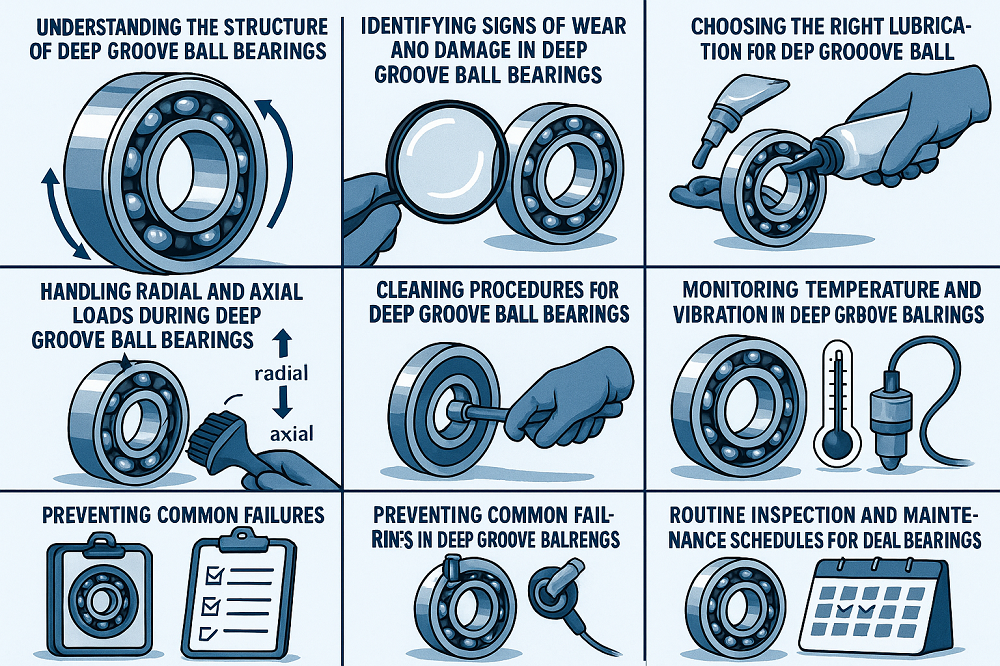
Recognizing the early signs of wear and damage in Deep Groove Ball Bearings is critical for ensuring reliability and preventing unexpected machine downtime. The physical and operational characteristics of these bearings provide multiple indicators that can be monitored to detect potential issues. One of the primary indicators is unusual noise, which often emerges when the balls, inner ring, or outer ring surfaces experience roughness or contamination. Regular monitoring of operational sounds using acoustic sensors, vibration detectors, or simple auditory inspection can reveal subtle irregularities. Noise may present as grinding, clicking, or squealing, each indicating different forms of wear such as raceway pitting, ball surface corrosion, or lubrication breakdown.
Vibration analysis is another essential method for identifying wear and damage in Deep Groove Ball Bearings. Bearings generate characteristic vibration patterns under normal operating conditions, and deviations from these patterns often indicate defects. Excessive vibration amplitude can result from uneven wear on the balls or raceways, misalignment, cage deformation, or contamination. Advanced techniques, including spectral analysis, allow maintenance teams to isolate vibration frequencies associated with specific defects, such as inner ring fault, outer ring fault, or ball defect frequencies. Understanding these vibration signatures enables targeted interventions before catastrophic failures occur.
Temperature changes provide another diagnostic tool for assessing Deep Groove Ball Bearings. Bearings operating under proper conditions exhibit stable temperatures within manufacturer-specified ranges. An increase in temperature may indicate insufficient lubrication, excessive load, friction between damaged surfaces, or contamination. Thermal monitoring devices, including infrared cameras, thermocouples, or onboard sensors, can provide continuous feedback on bearing conditions. Maintenance personnel must correlate temperature data with operational parameters to determine whether the bearing is experiencing abnormal stress or degradation.
Visual inspection is a straightforward yet effective method for detecting damage in Deep Groove Ball Bearings. Disassembly of the bearing allows close examination of the inner and outer rings, balls, cage, and raceways. Surface defects such as pitting, spalling, scratches, corrosion, or discoloration indicate wear or the presence of foreign particles. Pitting often arises from material fatigue or contamination, while spalling represents more advanced degradation, potentially leading to severe operational issues. Surface corrosion is frequently a result of moisture ingress, poor lubrication, or chemical exposure. Maintenance personnel must examine the bearing surfaces meticulously, looking for both obvious defects and subtle signs of surface degradation.
Lubricant condition offers another insight into the state of Deep Groove Ball Bearings. Contaminated, degraded, or insufficient lubrication accelerates wear and reduces operational efficiency. Grease that has changed color, thickened, or contains metallic particles suggests internal bearing wear. Oil analysis can detect microscopic particles generated by metal-to-metal contact, indicating early-stage degradation of balls, raceways, or cages. Routine lubricant sampling and laboratory testing allow maintenance teams to quantify wear debris, assess lubricant life, and plan timely replacement to prevent further damage.
Misalignment and improper installation contribute significantly to wear in Deep Groove Ball Bearings. Bearings subjected to angular misalignment, shaft deflection, or housing deformation may exhibit uneven wear patterns. Signs include localized surface wear on balls or raceways, uneven lubrication distribution, and increased vibration at specific operating speeds. Checking alignment tolerances using precision measurement tools such as dial indicators, laser alignment devices, or straightedges helps identify potential stress concentrations. Correcting misalignment issues is essential to prevent accelerated wear and maintain bearing functionality under load.
Load-related wear is another common indicator of damage in Deep Groove Ball Bearings. Bearings designed for specific radial and axial loads may show wear when subjected to overload conditions. Excessive radial load can produce indentations on raceways, flatten balls, or cause cage deformation. Axial overload may lead to uneven contact, localized wear, or increased friction along the groove edges. Monitoring operational loads and comparing them with manufacturer specifications helps identify instances where the bearing may be under undue stress. Observing changes in vibration, noise, or temperature can also signal load-induced wear patterns.
Contamination is a significant source of damage in Deep Groove Ball Bearings. Foreign particles such as dirt, dust, or metal shavings can enter the bearing through seals, shields, or improper handling. Contamination manifests as scratches, surface pitting, and accelerated fatigue of balls and raceways. Visual inspection, combined with lubricant analysis, can detect the presence of abrasive materials. Seals and shields should be examined for damage, misalignment, or deformation that could compromise their ability to prevent particle ingress. Implementing contamination control procedures, including clean handling practices and protective measures, is critical for minimizing wear and damage.
Cage condition provides valuable insight into the operational state of Deep Groove Ball Bearings. The cage maintains ball spacing and prevents collisions between balls, ensuring smooth rotation and even load distribution. Signs of cage wear include deformation, cracks, discoloration, and friction marks. A damaged cage can cause uneven rotation, increased friction, and accelerated wear on balls and raceways. Maintenance teams should inspect cages regularly during disassembly and monitor for unusual vibration patterns or noise that could indicate cage issues. Different cage materials, such as steel, brass, or polymer, may exhibit wear differently, and understanding these differences helps in diagnosing potential problems.
Axial play and radial clearance offer measurable indicators of wear in Deep Groove Ball Bearings. Bearings with increased clearance may indicate material loss due to surface wear or fatigue. Reduced clearance can suggest deformation of the rings, balls, or cage, or thermal expansion under operating conditions. Measurement tools such as dial indicators, micrometers, or specialized bearing gauges can quantify clearance changes. Monitoring these parameters over time allows maintenance personnel to identify trends of progressive wear, assess the severity of damage, and plan preventive interventions.
Corrosion and moisture ingress are frequent causes of wear in Deep Groove Ball Bearings, particularly in environments with high humidity or exposure to chemicals. Signs include rust on raceways, balls, or cages, discoloration, and surface roughness. Corrosion accelerates material fatigue and can compromise the bearing’s ability to support loads. Inspection protocols often include cleaning the bearing to reveal surface defects and applying protective coatings or lubricants to mitigate further damage. Bearings operating in corrosive environments may require specialized materials or seals to reduce exposure and prolong service life.
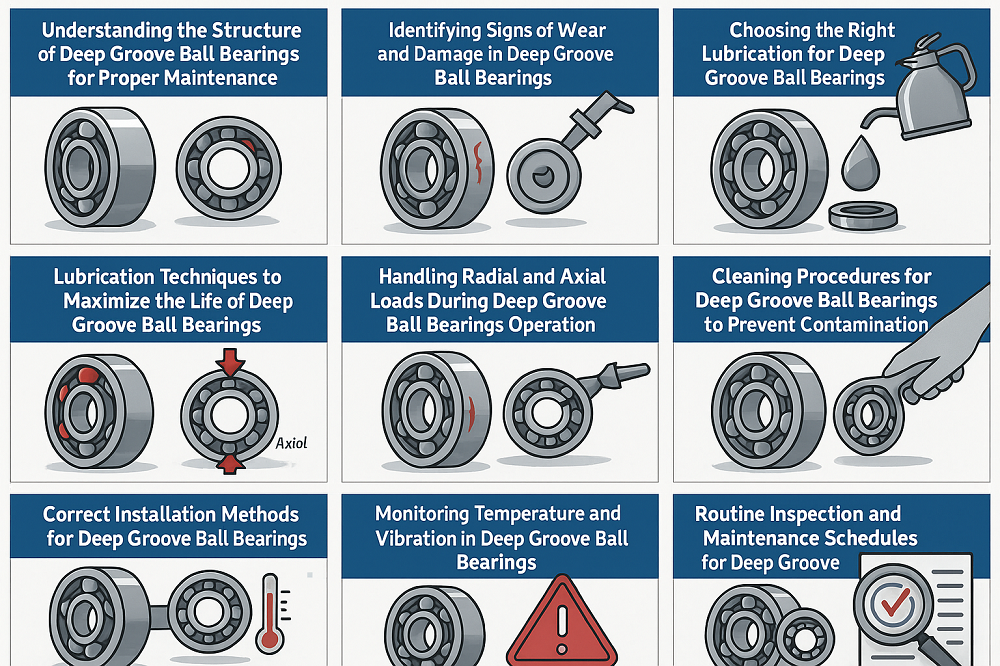
Proper lubrication is a critical factor in ensuring the smooth operation and longevity of Deep Groove Ball Bearings. Lubrication reduces friction, dissipates heat, protects against corrosion, and minimizes wear between the balls, raceways, and cages. Selecting the appropriate lubricant involves understanding the operating conditions, bearing materials, speed, load, environmental factors, and the design of the bearing itself. Lubrication choices directly affect the performance of Deep Groove Ball Bearings, making it essential for maintenance personnel to have comprehensive knowledge of grease and oil types, their additives, and application methods.
The first consideration when choosing lubrication for Deep Groove Ball Bearings is the type of bearing operation, whether it is high-speed, high-load, or continuous operation. Bearings operating at high rotational speeds require lubricants with low viscosity to reduce drag and heat buildup. Low-viscosity oils and light greases are often used in high-speed applications because they provide sufficient film thickness while minimizing resistance. Conversely, heavy-load or shock-load applications benefit from high-viscosity greases or oils with extreme pressure additives that enhance the lubricant’s ability to maintain a protective film under high contact stress. Maintenance teams must match the lubricant viscosity and additive package to the specific operational requirements to prevent metal-to-metal contact and wear.
Temperature is another critical factor influencing lubrication selection for Deep Groove Ball Bearings. Bearings operating in elevated temperature environments may require synthetic oils or high-temperature greases capable of maintaining viscosity and stability under heat. Standard mineral oils may break down, oxidize, or lose lubricating properties at high temperatures, leading to premature wear or bearing seizure. Low-temperature environments present the opposite challenge, where lubricants must remain fluid and avoid thickening or solidification. Maintenance protocols should include temperature monitoring to ensure that selected lubricants function effectively within the operational range of the Deep Groove Ball Bearings.
Environmental factors such as moisture, dust, and chemical exposure significantly influence lubricant choice. Bearings operating in wet or corrosive environments may require water-resistant greases or oils with corrosion inhibitors. Sealed Deep Groove Ball Bearings may retain lubrication longer and offer protection against contaminants, but the lubricant still needs to resist chemical attack and maintain film integrity. Bearings exposed to dust, dirt, or abrasive particles require lubricants that provide a protective barrier, carry contaminants away from critical surfaces, and prevent particle-induced wear. Maintenance personnel must assess environmental risks when specifying lubricant type and application frequency.
Load characteristics, including radial and axial forces, affect lubrication requirements for Deep Groove Ball Bearings. High radial loads increase contact stress between balls and raceways, demanding lubricants with high load-carrying capacity and anti-wear additives. Axial loads generate localized pressure along the groove surfaces, which also requires lubricants capable of maintaining a consistent protective film under stress. Lubricants containing extreme pressure (EP) additives or anti-wear (AW) components enhance the durability of the bearing by preventing micro-welding, scuffing, and surface fatigue under varying load conditions. Understanding the specific load profile allows maintenance teams to choose lubricants that balance performance and service life.
The type of bearing material is an additional factor in lubrication selection. Standard Deep Groove Ball Bearings made of chromium steel have different lubrication requirements compared to stainless steel or ceramic bearings. Stainless steel bearings may operate in corrosive environments and benefit from lubricants with higher corrosion resistance, whereas ceramic bearings can run at higher speeds with reduced friction and may require lighter oils or specialty greases. Maintenance practices must account for compatibility between lubricant additives and bearing materials, as some additives may chemically react with certain metals or polymers used in cages or seals.
Lubrication frequency and method are closely linked to the type of Deep Groove Ball Bearings and their operational conditions. Open bearings typically require more frequent lubrication to maintain a protective film, while sealed bearings retain grease and require less frequent maintenance. Manual lubrication involves applying grease directly to the bearing using a grease gun, ensuring that the lubricant reaches the balls, raceways, and cage. Automatic lubrication systems provide continuous oil or grease supply, which is beneficial in high-speed or hard-to-access applications. Maintenance personnel must determine the optimal lubrication interval based on operating speed, load, temperature, and environmental conditions to ensure continuous protection of the Deep Groove Ball Bearings.
The consistency and formulation of grease play a critical role in bearing performance. Grease is composed of a base oil, thickener, and additives. The base oil provides the primary lubricating film, while thickeners determine the grease’s consistency and ability to remain in place. Additives enhance performance by improving load capacity, wear resistance, oxidation stability, and corrosion protection. Selecting the correct NLGI grade is crucial; lower NLGI grades are softer and flow more easily at high speeds, while higher NLGI grades provide better adhesion and protection under high loads or shock conditions. Maintenance personnel must ensure that grease is compatible with bearing materials and operational requirements to avoid excessive heat generation or lubricant breakdown in Deep Groove Ball Bearings.
Oil lubrication is another approach for Deep Groove Ball Bearings, particularly in high-speed or continuous operation scenarios. Oils offer superior cooling, flow into small clearances, and can carry away contaminants more effectively than grease. Oil can be applied through immersion, circulating systems, or mist lubrication, depending on the application. Proper oil selection requires attention to viscosity, thermal stability, and additive composition. Oil-lubricated bearings demand monitoring of oil quality, contamination, and flow rate to maintain effective lubrication and prevent premature wear. Maintenance personnel often conduct regular oil analysis to detect metal particles, oxidation, or other indicators of bearing condition.
Contamination control is a significant aspect of lubrication maintenance for Deep Groove Ball Bearings. Dirt, metal shavings, and other particles can compromise lubricant performance and accelerate wear. Clean handling practices during installation, lubrication, and maintenance are essential to prevent foreign particles from entering the bearing. Sealed bearings reduce contamination risk, but lubrication must still maintain its protective properties over time. Regular inspection of grease consistency, oil clarity, and signs of additive depletion helps detect early signs of contamination or degradation in Deep Groove Ball Bearings.
Operational monitoring techniques complement lubrication practices. Bearing temperature, vibration, and noise provide real-time indications of lubrication effectiveness. Excessive heat can indicate insufficient lubricant, overloading, or friction caused by contamination. Vibration analysis can reveal uneven ball rotation, cage wear, or inadequate lubricant distribution. Acoustic monitoring can detect early-stage defects caused by inadequate lubrication. Integrating these monitoring techniques allows maintenance personnel to adjust lubrication intervals, replenish lubricant, or switch formulations to ensure optimal performance of Deep Groove Ball Bearings under varying operational conditions.
Additive selection for Deep Groove Ball Bearings requires careful consideration. Anti-wear (AW) additives protect metal surfaces from abrasion and micro-welding, extreme pressure (EP) additives maintain film integrity under high loads, and corrosion inhibitors prevent rust and chemical degradation. Oxidation inhibitors extend lubricant life at elevated temperatures, while friction modifiers reduce operating heat and energy consumption. Maintenance personnel must match the additive package to the bearing’s operational profile, materials, and environmental exposure. Improper additive selection can lead to premature lubricant breakdown, excessive wear, or chemical interactions that degrade the bearing surfaces.
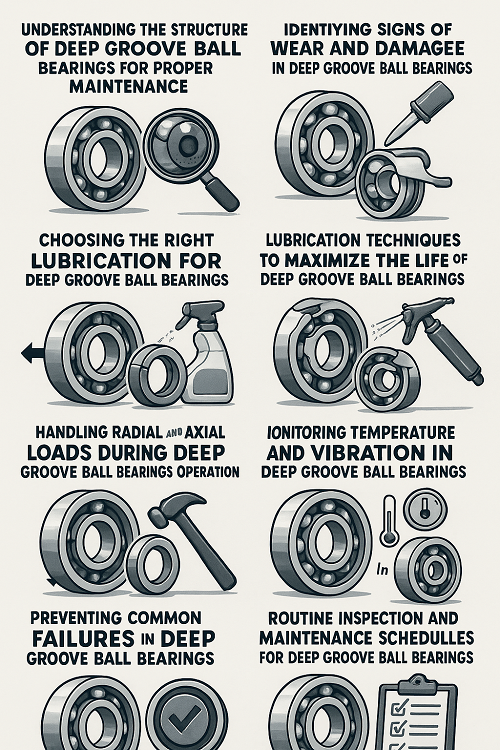
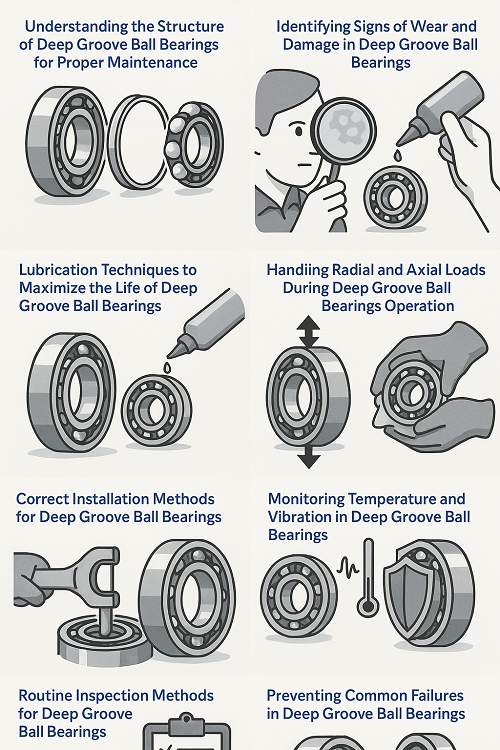
The effectiveness of Deep Groove Ball Bearings is closely linked to the application and management of lubrication. Proper lubrication techniques directly influence friction reduction, heat dissipation, wear prevention, and corrosion resistance. A thorough understanding of lubrication methods, frequency, quantity, and environmental factors is essential for maintenance teams to maintain optimal operation and prolong the service life of Deep Groove Ball Bearings. Different applications require tailored lubrication techniques, and selecting the correct approach depends on operating speed, load conditions, temperature, and bearing configuration.
Manual grease application remains one of the most common techniques for lubricating Deep Groove Ball Bearings. Grease is typically applied using grease guns or automated dispensing tools to deliver the correct amount directly to the bearing. The volume of grease must be carefully controlled; over-greasing can lead to increased friction, heat generation, and leakage, while under-greasing fails to provide adequate protection, resulting in premature wear. Maintenance personnel need to understand the bearing’s housing volume, rotational speed, and operating load to determine the precise quantity of grease required. In industrial systems, scheduled grease replenishment ensures that the lubricant maintains a continuous protective film on all contact surfaces of the Deep Groove Ball Bearings.
Oil lubrication offers a different set of techniques, particularly suitable for high-speed or continuously operating Deep Groove Ball Bearings. Circulating oil systems, including splash, drip, and forced circulation methods, provide continuous replenishment and cooling. Splash lubrication involves partially immersing the bearing in an oil bath, allowing rotation to distribute lubricant evenly. Drip lubrication provides precise control by delivering oil directly onto the bearing at controlled rates, reducing excess heat and minimizing waste. Forced circulation systems pump oil through the bearing assembly and return it to a reservoir for filtration, which is particularly useful in high-load or high-temperature applications where heat dissipation is critical. Each method requires careful monitoring of oil flow, temperature, and contamination levels to maintain the integrity of Deep Groove Ball Bearings.
Automatic lubrication systems further enhance bearing performance by providing continuous or periodic delivery of lubricant without manual intervention. These systems can be configured for grease or oil lubrication and are often controlled by timers, sensors, or computerized monitoring. Automated lubrication reduces human error, ensures consistent lubrication intervals, and allows precise control over the quantity of lubricant delivered. The placement of lubrication points, line sizing, and system pressure are critical for ensuring that all balls and raceways of Deep Groove Ball Bearings receive sufficient coverage. These systems are particularly advantageous in applications where bearings are difficult to access or operate under high speeds, heavy loads, or continuous duty cycles.
Centrifugal and rotational effects within Deep Groove Ball Bearings influence the distribution of lubricant and must be considered when applying lubrication. At high rotational speeds, grease may migrate away from the contact zones or accumulate in pockets, reducing its effectiveness. Maintenance personnel can mitigate these issues by selecting lubricants with appropriate viscosity, consistency, and thixotropic properties, which allow the grease to remain in the raceway while providing fluidity under rotation. Lubricant flow within the bearing should reach all balls and cage surfaces to prevent localized dry spots and uneven wear.
The temperature of the bearing and surrounding environment is another critical factor in lubrication technique selection for Deep Groove Ball Bearings. High-temperature conditions can cause grease to thin or oils to oxidize, while low temperatures can increase viscosity and reduce flowability. Bearings operating in environments with fluctuating temperatures require lubricants with stable viscosity indices, thermal resistance, and oxidation stability. Maintenance protocols often include monitoring bearing temperature and selecting lubricant formulations capable of maintaining protective properties across the expected operational range. In some cases, high-temperature synthetic oils or specialized greases with thermal stability additives are employed to prevent premature lubricant breakdown.
Contamination control is tightly integrated with lubrication techniques for Deep Groove Ball Bearings. Particles, moisture, and chemical contaminants can compromise lubricant performance and accelerate wear. During lubrication, strict adherence to cleanliness protocols is essential to prevent foreign matter from entering the bearing. Tools, reservoirs, and applicators must be free from dirt, metal shavings, and residual contaminants. Sealed or shielded Deep Groove Ball Bearings reduce the risk of contamination, but periodic inspection ensures that seals maintain integrity and lubricant remains uncontaminated. Filtration systems in circulating oil lubrication help remove debris and maintain lubricant quality over time.
Bearing speed, load, and operational cycle play a crucial role in determining the frequency and method of lubrication. High-speed Deep Groove Ball Bearings require more frequent replenishment with low-viscosity lubricants to maintain a continuous protective film and avoid heat buildup. Heavy-load or shock-load bearings benefit from high-viscosity greases or oils containing extreme pressure additives that resist film breakdown under stress. Maintenance teams must balance lubrication frequency and volume to match operational demands, ensuring that the lubricant provides sufficient protection without causing excessive drag or heat.
The type of cage in Deep Groove Ball Bearings also affects lubrication technique. Steel, brass, and polymer cages have different frictional characteristics and thermal properties. Steel cages generate more heat and may require higher lubricant volumes or enhanced cooling techniques. Polymer cages are sensitive to high temperatures and chemical incompatibility, so lubricant selection must avoid components that could degrade the cage material. Proper lubrication ensures even ball spacing, smooth rotation, and uniform load distribution, reducing the risk of localized wear and fatigue.
Lubrication techniques must also consider the method of bearing installation and housing design. Bearings mounted in tight or enclosed housings may require grease injection through fittings or oil circulation channels to reach internal surfaces effectively. Open bearings may allow direct application, but the lubricant must reach all balls, raceways, and cage surfaces to maintain consistent protection. Maintenance teams must ensure that lubrication is evenly distributed and that excess grease or oil does not leak or accumulate in areas that can generate heat or friction, which can adversely affect Deep Groove Ball Bearings.
Monitoring and adjusting lubrication during operation is an ongoing maintenance task. Temperature, vibration, and noise measurements provide insights into the effectiveness of the lubrication technique. Bearings exhibiting elevated temperatures may indicate insufficient lubrication, excessive load, or contamination. Vibration analysis can reveal uneven rotation, cage issues, or partial lubrication, allowing maintenance personnel to adjust lubricant type, quantity, or delivery method. Acoustic monitoring identifies early-stage defects related to inadequate lubrication, enabling corrective action before more severe damage occurs.
Lubricant compatibility with bearing material and environmental conditions must be maintained for Deep Groove Ball Bearings. Certain additives may react with metals or polymers used in bearings, causing degradation or increased wear. Maintenance teams need to consider the chemical stability, oxidation resistance, and thermal tolerance of lubricants when selecting techniques for application. For example, bearings operating in corrosive or high-moisture environments require water-resistant or chemically stable greases that maintain protective properties even in challenging conditions. Choosing the correct lubrication technique, including delivery method, frequency, and lubricant type, ensures that Deep Groove Ball Bearings operate with minimal friction, controlled heat, and extended operational efficiency.
The ability of Deep Groove Ball Bearings to manage radial and axial loads is central to their operational reliability and performance. Radial loads are forces applied perpendicular to the shaft axis, while axial loads are parallel to the shaft. The design of Deep Groove Ball Bearings, including raceway geometry, ball size, cage structure, and contact angle, determines their capacity to withstand combined loading conditions. Maintenance personnel must understand the load characteristics of the application to ensure that bearings operate within safe limits and maintain optimal performance under varying conditions.
Radial load handling in Deep Groove Ball Bearings relies on the distribution of force through the balls to the raceways. The balls rotate within the grooves of the inner and outer rings, transferring the radial load efficiently while minimizing friction. Bearings designed for heavy radial loads often have larger balls or reinforced raceways to increase load-carrying capacity. Maintenance teams monitor wear patterns on the raceways and balls to identify uneven loading, which may indicate misalignment, shaft deflection, or improper installation. Observing surface wear, pitting, or brinelling in the raceways provides insight into how effectively the bearing manages radial forces.
Axial load handling in Deep Groove Ball Bearings is facilitated by the shallow contact angle between the balls and raceways. This angle allows the bearing to resist moderate axial forces in both directions. Bearings subjected to high axial loads require precise alignment to prevent uneven pressure along the grooves. Misalignment can lead to localized stress, accelerated wear, and increased friction, affecting both radial and axial performance. Maintenance practices involve checking axial displacement, measuring end play, and ensuring that shafts and housings are properly positioned to prevent overloading of the axial capacity of the Deep Groove Ball Bearings.
The interaction between radial and axial loads affects lubrication requirements. Bearings under combined loading experience varying pressure distributions, which influence the lubricant film between balls and raceways. Insufficient lubrication under high combined loads can lead to surface fatigue, scuffing, and heat buildup. Maintenance personnel must consider the load profile when selecting lubricant type, viscosity, and application method to ensure that all contact surfaces of Deep Groove Ball Bearings receive adequate coverage. Regular monitoring of operating temperature and vibration provides feedback on the effectiveness of lubrication under load.
Load-induced stress in Deep Groove Ball Bearings also impacts cage performance. The cage maintains ball spacing and distributes loads evenly across the raceways. Excessive radial or axial forces can cause cage deformation, leading to misalignment of the balls, increased friction, and uneven wear. Maintenance inspections include evaluating cage integrity, checking for cracks, discoloration, or friction marks, and ensuring that the balls rotate freely within the retainer. The choice of cage material, whether steel, brass, or polymer, influences the bearing’s ability to handle loads, and lubrication techniques must account for material-specific properties.
Bearing geometry directly affects the handling of radial and axial loads. The depth of the grooves, ball diameter, and clearance all determine how the load is transmitted and distributed. Bearings with deeper grooves can better accommodate axial forces, while larger balls enhance radial load capacity. Internal clearance, including radial and axial play, must be measured to ensure that Deep Groove Ball Bearings operate within specified tolerances. Excessive clearance can lead to vibration, noise, and uneven wear, while insufficient clearance may increase friction, heat, and the risk of seizure under high loads.
Misalignment and shaft deflection are critical considerations when Deep Groove Ball Bearings carry combined loads. Radial misalignment can create uneven pressure distribution across the balls and raceways, while axial misalignment can generate localized stress along the groove edges. Both conditions increase the likelihood of surface fatigue, pitting, and spalling. Maintenance personnel use dial indicators, laser alignment tools, or other precision measurement devices to assess alignment. Corrective actions include repositioning the bearing, adjusting housing tolerances, or using bearing designs tolerant of misalignment to maintain operational reliability under radial and axial loads.
Load distribution within the bearing also interacts with thermal expansion of components. Deep Groove Ball Bearings experience dimensional changes in the inner ring, outer ring, balls, and cage due to temperature variations during operation. Unequal expansion can alter the contact angles, internal clearance, and load sharing, potentially creating excessive stress points. Maintenance teams monitor operating temperatures and consider thermal effects when setting preloads or selecting lubrication techniques. Bearings designed for high-speed or high-load conditions may incorporate specialized materials or coatings to reduce friction and accommodate thermal variation, ensuring that radial and axial loads remain effectively managed.
Vibration analysis is a valuable tool for assessing load management in Deep Groove Ball Bearings. Radial and axial forces generate characteristic vibration patterns, and deviations from normal signatures indicate uneven load distribution or potential defects. High radial loads may cause increased amplitude at specific frequencies corresponding to ball pass frequencies, while axial misalignment may produce harmonics or transient spikes. Maintenance personnel interpret vibration data to identify load-induced issues, including cage deformation, ball or raceway wear, or lubrication insufficiency, and adjust operational parameters accordingly.
Dynamic loading conditions require attention to material fatigue in Deep Groove Ball Bearings. Repeated radial and axial forces can initiate micro-cracks in the raceways or balls, which propagate over time and lead to spalling or flaking. Bearings subjected to cyclic loads benefit from careful selection of materials with high fatigue resistance, precise heat treatment, and surface finishing to reduce stress concentrations. Maintenance inspections focus on early signs of fatigue, such as discoloration, indentation, or small surface defects, allowing interventions before failure becomes severe.
Shock loads and impact forces present additional challenges for handling radial and axial stresses in Deep Groove Ball Bearings. Bearings exposed to sudden load spikes may experience momentary deformation, micro-welding, or surface indentation. Cage stability under impact is also critical to prevent misalignment or ball collision. Maintenance procedures involve monitoring operational conditions, selecting lubricants with high extreme-pressure capacity, and ensuring that bearings are installed with proper fit and alignment. Structural reinforcement, such as using larger balls or hardened raceways, may be implemented for applications with frequent shock loading.
The distribution of radial and axial loads is influenced by shaft and housing design. Misaligned housings, uneven shaft supports, or improper bearing seating can create uneven load sharing, leading to localized wear or cage deformation. Maintenance teams examine housing tolerances, shaft geometry, and bearing seating to ensure even load transfer. Techniques such as precision machining, alignment shims, or tapered fits are used to maintain correct load distribution and prevent excessive stress concentrations in Deep Groove Ball Bearings.
Lubrication behavior under combined loads requires careful consideration. High radial forces may force lubricant out of the contact zone, while axial loading can create pressure differentials that impede oil or grease flow. Ensuring consistent lubricant distribution is crucial for preventing metal-to-metal contact and excessive wear. Maintenance practices include adjusting lubricant viscosity, selecting appropriate delivery methods, and monitoring lubricant condition to accommodate radial and axial stresses. Bearings operating under varying load conditions may require adaptive lubrication strategies to maintain continuous protection and smooth operation.
Deep Groove Ball Bearing Basics What is a Deep Groove Ball Bearing? A deep groove ball bearing is th...
READ MOREIntroduction to Deep Groove Ball Bearings What Are Deep Groove Ball Bearings? A deep groove ball bea...
READ MOREUnderstanding the Structure of Deep Groove Ball Bearings for Proper Maintenance Deep Groove Ball Bea...
READ MOREIntroduction to Deep Groove Ball Bearings In the world of mechanical engineering and rotating machin...
READ MORE


