

 English
  русский
  Español

From entry to master: a complete manual for the installation and maintenance of deep groove ball bearings
Deep Groove Ball Bearing Basics What is a Deep Groove Ball Bearing? A deep groove ball bearing is th...
READ MOREIn the world of mechanical engineering and rotating machinery, few components are as fundamental and widely used as deep groove ball bearings. These unsung heroes of motion are integral to countless devices, from simple household appliances to complex aerospace systems. Known for their simplicity, versatility, and efficiency, deep groove ball bearings are the most common type of rolling element bearing, a class of mechanical component designed to reduce friction and support loads.
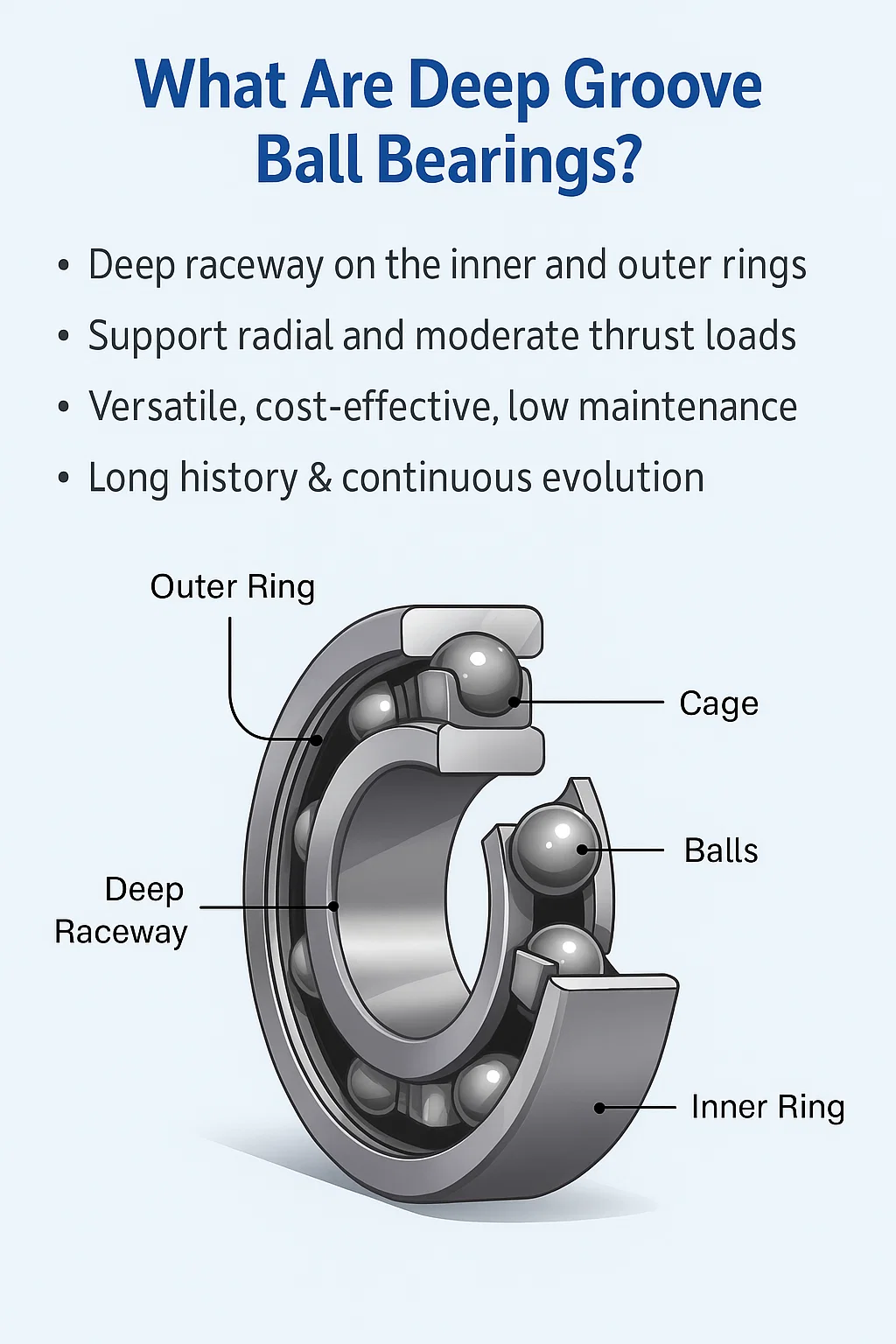
A deep groove ball bearing is a type of bearing that features a deep, uninterrupted raceway on both the inner and outer rings. This raceway has a radius slightly larger than that of the balls, which allows the bearing to handle both radial load (the force perpendicular to the shaft) and moderate thrust load or axial load (the force parallel to the shaft). The core components include an inner ring, an outer ring, a set of precision ball bearings, and a cage to keep the balls properly spaced and guided. This design ensures smooth and efficient rotation, minimizing friction and energy loss.
The widespread use of deep groove ball bearings is a testament to their exceptional characteristics and benefits.
Versatility: Their unique raceway design allows them to effectively support both radial load and a significant degree of thrust load, making them suitable for a vast range of bearing applications.
High-Speed Capability: With a low friction coefficient, these bearings are ideal for high-speed operation.
Cost-Effectiveness: They are one of the most widely manufactured bearing types, which translates to a high level of standardization and lower cost compared to other specialty bearings.
Low Maintenance: Many deep groove ball bearings are available in sealed or shielded versions, pre-lubricated for life, requiring little to no bearing maintenance.
Quiet Operation: Their precision design ensures smooth rotation, resulting in low noise and vibration levels.
The concept of using rolling elements to reduce friction dates back centuries, with early designs sketched by Leonardo da Vinci. However, the modern ball bearing as we know it began to take shape during the Industrial Revolution, as the need for more efficient machinery grew. The deep groove ball bearing design was pioneered in the late 19th and early 20th centuries, with key innovations focusing on the raceway geometry and manufacturing precision. Over time, advancements in bearing materials, lubrication, and manufacturing techniques have allowed for higher load capacities, increased speeds, and extended service life, making them the robust and reliable components they are today. This evolution has solidified their position as an indispensable component in nearly every industry.
While all deep groove ball bearings share a fundamental design, they are manufactured in various configurations to meet the specific demands of different bearing applications. Understanding these distinct bearing types is crucial for selecting the right component for a particular task. The main distinctions lie in the number of ball rows and the type of sealing or shielding employed.
This is the most widely used and recognizable ball bearing type. As their name suggests, they feature a single row of ball bearings between the inner and outer rings. Single row bearings are highly versatile, capable of handling significant radial load and, due to their deep raceway grooves, a moderate thrust load in both directions. Their robust and simple design makes them suitable for a vast range of uses, from electric motors and automotive components to power tools and home appliances. Their low friction and high-speed capabilities make them an excellent choice for a majority of general-purpose bearing applications.
For applications that demand greater load capacity and rigidity than a single row bearing can provide, the double row deep groove ball bearing is the ideal solution. Essentially two single row bearings combined into a single unit, this type features two parallel rows of balls. The double row design significantly increases the bearing's radial and axial load capacity. The wider support base also provides greater stability and rigidity, making them particularly effective in scenarios where a shaft needs to be held firmly in place. While larger and more specialized, they are an excellent choice for heavy-duty machinery, agricultural equipment, and industrial pumps where performance under high loads is a priority.
Miniature ball bearings are a specialized type of deep groove ball bearing defined by their very small dimensions, with an outer diameter of less than 30 mm. Despite their tiny size, they are engineered to the same high specifications as their larger counterparts. These bearings are critical components in precision instruments and equipment where space is extremely limited. Common applications include dental drills, robotics, medical instruments, computer fans, and other small-scale mechanical devices. Their design prioritizes low friction and smooth operation, making them a vital part of miniature, high-speed, and precision systems.
The protection of the internal components and the lubrication is paramount for the longevity and performance of any bearing. Deep groove ball bearings come in three primary protection configurations:
Open Bearings: This basic type has no seals or shields. The internal components are exposed, which is beneficial for applications where the bearing is regularly lubricated with oil or grease from an external source or is operating in a clean environment. They offer the lowest friction and are capable of the highest speeds.
Shielded Bearings: Designated with a "Z" (for one shield) or "ZZ" (for two shields), these bearings feature non-contact metal shields pressed into the outer ring. These shields prevent large particles from entering the bearing while allowing some lubricant to escape and offering a slightly higher speed limit than sealed bearings. They are suitable for environments with minimal contamination.
Sealed Bearings: Designated with an "RS" (for one rubber seal) or "2RS" (for two rubber seals), these bearings have a flexible rubber lip seal that makes contact with the inner ring. This design provides superior protection against both solid contaminants and moisture. They are pre-lubricated with grease for life and are a popular choice for bearing applications in dusty or wet environments. The trade-off is slightly increased friction, which results in a lower speed limit compared to open or shielded bearings.
Understanding these different bearing types and their specific features is the first step in ensuring a successful installation and a long, reliable service life.
The versatility and reliability of deep groove ball bearings make them a cornerstone in virtually every industry that relies on rotating machinery. From heavy industrial equipment to everyday consumer products, these essential components are engineered to perform in a wide variety of environments. The following are some of the most prominent bearing applications where their unique characteristics are leveraged for optimal performance.
The automotive sector is a major consumer of deep groove ball bearings. They are indispensable for the smooth and efficient operation of a vehicle's many rotating parts. You can find them in wheel hubs, where they support the vehicle's weight and ensure the wheel spins freely with minimal friction. They are also crucial inside transmissions and alternators, where they handle high speeds and the combined radial load and thrust load generated during operation. The durability and long-life specifications of ball bearings are vital for ensuring vehicle reliability and safety over thousands of miles.
Electric motors, the workhorses of both industrial and domestic applications, rely heavily on deep groove ball bearings to support the rotor shaft. The bearings allow the shaft to rotate at high speeds with minimal energy loss. Their low friction and quiet operation are particularly important in electric motors, as they contribute to a motor's overall efficiency and noise reduction. Whether in a small-scale fan motor or a large industrial motor for factory equipment, the performance of the bearing directly impacts the motor's lifespan and output.
In pumps and compressors, deep groove ball bearings are critical for supporting the rotating shafts that move fluids or compress gases. These applications often involve high speeds and significant radial load from the impeller or piston. The bearings must be robust enough to withstand these forces while maintaining precise alignment to prevent wear and tear. Their reliability in these demanding conditions ensures the consistent and efficient performance of fluid handling systems in HVAC units, industrial processes, and water treatment plants.
The convenience of modern life is often powered by small electric motors, all of which use deep groove ball bearings. From the drum of a washing machine to the internal mechanisms of a vacuum cleaner, these bearings enable the quiet and smooth rotation of moving parts. They are also found in power tools, such as drills, saws, and grinders, where they must withstand the jarring forces and high speeds of operation. The low maintenance requirements of sealed ball bearings make them ideal for consumer products where lubrication and servicing are not typically part of the user's routine.
In the aerospace industry, the stakes are incredibly high, and the reliability of every component is paramount. Deep groove ball bearings are used in critical applications ranging from flight control systems and landing gear to engine accessories. These bearings are manufactured to extremely precise specifications and are often made from specialized materials to perform under extreme temperatures and pressures. While the principles of a standard bearing apply, the quality and bearing materials used in aerospace are tailored for absolute reliability, demonstrating the immense trust placed in this fundamental component.
The performance and longevity of a deep groove ball bearing are fundamentally determined by the bearing materials used in its construction. While the basic design of a bearing remains constant, the choice of material for the rings, balls, and cage is tailored to the specific demands of the application, including load, speed, temperature, and environmental factors.
For the vast majority of bearing applications, chrome steel is the standard material for the inner and outer rings, as well as the ball bearings themselves. This material, typically a high-carbon chromium steel (such as AISI 52100), offers an exceptional balance of hardness, wear resistance, and fatigue strength. It is heat-treated to achieve a Rockwell hardness of around 60-64 HRC, making it incredibly durable and capable of withstanding high radial load and thrust load. The reliability and cost-effectiveness of chrome steel have made it the go-to choice for general-purpose deep groove ball bearings in countless industries.
When a bearing is required to operate in a corrosive environment, such as in food processing, medical equipment, or marine applications, stainless steel is the preferred material. Stainless steel bearings are made from high-chromium alloys (like AISI 440C) that provide excellent resistance to moisture, chemicals, and rust. While not as hard as chrome steel, which can result in a slightly lower dynamic load capacity, their superior corrosion resistance is a critical advantage. This makes them an essential component for applications where sanitation and resistance to chemical cleaners are non-negotiable.
For high-performance, specialized bearing applications, ceramic materials represent a significant leap in technology. These bearings typically feature balls made from materials like Silicon Nitride () or Zirconia (), which are often paired with steel rings to create a "hybrid bearing." The benefits of ceramic bearings are substantial: they are significantly lighter than steel, non-magnetic, and resistant to corrosion. Their high stiffness and lower thermal expansion allow for higher precision and the ability to operate at much higher speeds and temperatures with minimal lubrication. While offering unparalleled performance, the high cost of ceramic materials means they are primarily used in critical applications such as aerospace, motorsports, and specialized high-speed machinery.
The bearing's cage, also known as a retainer, serves the crucial function of separating the balls and guiding them evenly around the raceway. The material of the cage is selected based on speed, temperature, and lubrication requirements.
Pressed Steel Cages: The most common type, these are stamped from sheet metal and are robust, durable, and economical. They are suitable for most general-purpose bearing applications.
Machined Brass Cages: Used for larger bearings or in more demanding conditions, brass cages are stronger and more stable at high temperatures and speeds. They offer better performance in applications with poor lubrication and are common in industrial gearboxes and pumps.
Polyamide Cages (Nylon): Molded from a reinforced polymer, these cages are lightweight, flexible, and offer excellent low-friction properties. They are ideal for high-speed, low-noise applications and are resistant to certain chemicals. However, they have a limited temperature range and are not suitable for extremely hot environments.
The careful selection of these bearing materials is a vital part of the specifications process, ensuring the bearing is perfectly matched to its intended function and environment.
Choosing the right deep groove ball bearing for a given application requires more than just knowing its dimensions. A fundamental understanding of bearing specifications, particularly load capacity and speed ratings, is essential for ensuring reliability and longevity. These ratings define the limits of a bearing's performance and are critical factors in the selection process.
Every bearing is designed to support a specific type of force or load. Deep groove ball bearings are particularly versatile because they can handle both radial load and axial load.
Radial Load: This is the force that acts perpendicularly to the shaft. It is the primary load that most deep groove ball bearings are designed to support, with their deep raceways providing excellent support for these forces.
Axial Load (or Thrust Load): This is the force that acts parallel to the shaft. While some bearing types are designed specifically for thrust load, the deep raceway geometry of deep groove ball bearings allows them to handle moderate axial load in both directions. This dual-purpose capability makes them an ideal choice for applications with combined loading conditions.
Manufacturers provide two key load ratings for bearings, which are vital for bearing applications:
Static Load Rating (): The static load rating represents the maximum load a stationary bearing can withstand without causing permanent deformation to the raceways or ball bearings. Exceeding this value, even for a moment, can lead to indentations and significantly reduce the bearing's future performance and lifespan. This rating is crucial for applications where bearings are subject to heavy loads during rest, such as a crane supporting a heavy weight before lifting.
Dynamic Load Rating (): The dynamic load rating is the most critical factor for bearings that operate under rotation. It is defined as the constant radial load that a group of identical bearings can endure for one million revolutions before 90% of them show the first signs of material fatigue. This rating is used in the bearing life calculation formula, , where is the nominal life in millions of revolutions, is the dynamic load rating, and is the equivalent dynamic load. This relationship highlights a crucial principle of bearing maintenance: a small reduction in operating load can lead to a dramatically longer bearing life.
A bearing's speed rating, typically expressed in revolutions per minute (RPM), indicates the maximum speed at which it can safely operate without generating excessive heat that could lead to premature bearing failure. The speed limit is not a fixed value but is influenced by several factors:
Lubrication: The type and method of lubrication (grease vs. oil) have a significant impact on speed capacity. Oil lubrication generally allows for higher speeds than grease.
Bearing Design: As previously discussed, bearing types with less friction, such as open or shielded bearings, can handle higher speeds than their sealed counterparts (2RS) due to the reduced drag from the contact seals.
Load and Temperature: Heavier loads and higher operating temperatures generate more heat, which can necessitate a lower operating speed to prevent thermal damage to the bearing and its lubricant.
By carefully considering these specifications, engineers can select a deep groove ball bearing that not only fits the physical constraints of a design but also meets the demanding performance requirements for a long and reliable service life.
The performance and service life of a deep groove ball bearing are heavily dependent on correct installation and handling. Even a high-quality bearing can suffer premature bearing failure if it is not mounted properly. Following best practices during installation is just as important as selecting the right type and specifications for your application.
The fundamental rule of bearing installation is to apply force only to the ring that is being press-fitted. Applying force to the wrong ring can transmit the load through the ball bearings, causing damage to the raceways and a significant reduction in the bearing’s life. There are three primary methods for mounting:
Mechanical Mounting: For small to medium-sized bearings, this is the most common method. It involves using a mounting sleeve and a hammer or a mechanical press. The sleeve distributes the force evenly around the ring. If the bearing is being mounted onto a shaft, the force must be applied to the inner ring. If it is being mounted into a housing bore, the force should be applied to the outer ring.
Hydraulic Mounting: For larger bearings, a hydraulic press offers a controlled and even force, minimizing the risk of damage. The pressure can be precisely regulated, ensuring the bearing is seated correctly without over-stressing the components.
Thermal Mounting (Heating): This is the safest and most recommended method for bearing installation. By heating the bearing (typically to a temperature of 80-100°C), the inner ring expands, allowing it to slide easily onto the shaft. This method eliminates the need for any forceful impact, protecting the bearing from damage. Specialized induction heaters or controlled oil baths are used to ensure uniform and safe heating.
Having the right tools is essential for a smooth and successful installation. Key tools include:
Bearing Pullers: Used for the safe and non-destructive removal of old bearings.
Mounting Tool Kits: These kits contain a set of sleeves and an impact hammer, designed to provide correct force application for different bearing sizes.
Induction Heaters or Heating Plates: For the thermal installation method, these tools provide a safe and controlled way to heat the bearing evenly.
Precision Measuring Tools: Micrometers and calipers are used to check the dimensions of the shaft and housing to ensure the correct fit and clearance.
Carelessness during installation is a leading cause of premature bearing failure. Be mindful of these common mistakes:
Incorrect Force Application: The most frequent error is applying impact force to the outer ring when fitting a bearing to a shaft, or vice-versa. This can lead to Brinelling (indentations on the raceway), which drastically shortens the bearing’s lifespan and can lead to immediate bearing failure.
Contamination: Dirt, dust, and other contaminants are a bearing’s worst enemy. Even microscopic particles can cause abrasive wear and damage. Always work in a clean environment and use clean tools.
Overheating: Heating a bearing above the recommended temperature can permanently alter the hardness of the steel, leading to a loss of strength and potential bearing failure.
Using an Improper Fit: An installation with too tight a fit on the shaft or in the housing can reduce the bearing’s internal clearance, causing excessive preload and heat. Conversely, a loose fit can lead to shaft creep and fretting corrosion. Always check specifications and tolerances.
Improper Lubrication: While lubrication is its own topic, using the wrong type or amount of lubricant during installation can be a critical error. Always follow the manufacturer’s recommendations.
Proper installation is a critical step in the bearing maintenance lifecycle. Taking the time to use the correct tools and techniques will ensure your deep groove ball bearings perform to their full potential and provide a long, reliable service life.
After proper installation, effective lubrication is the single most important factor for the long-term health and performance of a deep groove ball bearing. In fact, a significant percentage of all bearing failure is directly attributable to improper lubrication, whether it's due to the wrong type of lubricant, insufficient quantity, or contamination. Bearing maintenance is incomplete without a solid lubrication plan.
Lubrication performs several critical functions that ensure a bearing operates efficiently and reliably:
Reduces Friction: The primary role of lubrication is to form a thin film between the rolling elements (the balls) and the raceways. This film prevents direct metal-on-metal contact, drastically reducing friction, heat generation, and wear.
Protects from Wear: By creating a barrier, lubrication prevents surface fatigue and abrasive wear caused by tiny particles. It also protects the bearing surfaces from corrosion.
Dissipates Heat: As a bearing operates, it generates heat. The lubricant helps to carry this heat away from the critical surfaces, preventing thermal damage to the bearing and extending its service life.
Seals Against Contaminants: In addition to the seals or shields on the bearing itself, the lubricant (especially grease) acts as a secondary barrier, preventing the ingress of dust, dirt, and moisture that could otherwise cause significant damage.
The choice between grease and oil as a lubricant depends heavily on the bearing's operating conditions, specifications, and application.
Grease: Grease is the most common lubricant for deep groove ball bearings. It is a semi-solid substance made by combining a base oil with a thickener. Its main advantages are that it stays in place, providing excellent sealing properties and requiring less frequent re-lubrication. This makes it an ideal choice for bearings that are sealed for life (2RS, ZZ). However, the churning of the grease at very high speeds can generate heat and is generally not recommended for extremely high-RPM applications.
Oil: Oil lubrication is typically used in high-speed, high-temperature, or high-load applications where a constant flow of lubricant is required. Oil is better at dissipating heat and carrying away contaminants. It is also the preferred type for systems with a centralized lubrication system, where oil can be continuously supplied and filtered. The main drawback is the need for more complex sealing arrangements to prevent leakage.
A common misconception is that bearings are maintenance-free. While sealed bearings are designed for a specific service life, most other bearing types require periodic re-lubrication to replenish the lubricant and remove old, contaminated grease. Determining the correct interval is crucial and depends on:
Operating Conditions: A bearing operating at high speeds, high temperatures, or under heavy radial load will require more frequent re-lubrication than one in a low-speed, low-load application.
Environment: A hostile environment with moisture, dust, or dirt will necessitate more frequent bearing maintenance to flush out contaminants.
Manufacturer Recommendations: Always consult the bearing manufacturer's technical guides for specific lubrication intervals based on the bearing type and specifications.
It is equally important to avoid over-lubricating. Filling a bearing cavity with too much grease can cause a buildup of pressure, leading to seal damage and increased heat generation from churning, which can ultimately lead to a premature bearing failure. The correct amount is typically filling 30-50% of the free space inside the bearing housing.
A proactive bearing maintenance program is key to preventing unexpected downtime and extending the service life of your equipment. While deep groove ball bearings are robust, they are not immune to wear and tear. Regular inspection and a solid understanding of common bearing failure modes can help you identify and address issues before they lead to costly repairs.
Routine inspections are the first line of defense against bearing failure. Visual and audible checks can often reveal a problem early on.
Visual Inspection: Look for signs of damage on the bearing or surrounding components. Check for leaked or discolored grease, which can indicate overheating. The presence of rust or corrosion on the shaft or housing is a clear sign of moisture ingress.
Audible and Haptic Inspection: A healthy bearing should operate smoothly and quietly. A trained ear can detect unusual sounds like grinding, clicking, or rattling, which often signal internal damage or contamination. A mechanical stethoscope can help pinpoint the source of the noise. Similarly, a high temperature (when compared to the normal operating temperature) can be a red flag for issues with lubrication or overload. Vibration analysis tools can also provide a more precise diagnosis by identifying specific fault frequencies.
For open deep groove ball bearings that are not sealed, periodic cleaning and re-lubrication are part of routine bearing maintenance.
Cleaning: The bearing should be carefully removed from its application and cleaned with a non-flammable cleaning solvent like mineral spirits or kerosene. The bearing should be soaked and agitated to dislodge old, contaminated grease. Never spin a bearing with compressed air as this can cause it to rotate at extreme speeds and damage the raceways or ball bearings.
Drying and Re-lubrication: After cleaning, the bearing must be completely dried to prevent corrosion. Once dry, it should be immediately re-lubricated with the correct amount and type of grease as specified by the manufacturer. It is important to remember that sealed or shielded bearings (ZZ or 2RS) are typically "lubricated for life" and are not designed to be opened, cleaned, or re-lubricated.
Understanding the root cause of a bearing failure is the most crucial step in troubleshooting.
Fatigue: The most common form of bearing failure is material fatigue, which manifests as flaking or spalling on the raceways. This is a sign that the bearing has reached the end of its calculated service life, a result of the millions of stress cycles it has endured.
Contamination: Abrasive particles like dirt, dust, and metal shavings are responsible for a large percentage of premature bearing failure. They cause tiny indentations on the raceways and ball bearings, leading to rapid wear and a "grinding" noise.
Improper Lubrication: Both over- and under-lubrication can cause a bearing to fail. A lack of lubricant leads to metal-on-metal contact and excessive wear, while too much grease can cause heat buildup and seal damage.
Corrosion: Rust and corrosion on the bearing surfaces are typically caused by water or corrosive chemicals. This can lead to pitting, which disrupts the smooth raceway surface and accelerates wear.
Improper Installation: As discussed previously, applying force incorrectly during installation can cause damage, such as Brinelling, leading to premature bearing failure and noise.
Here is a quick guide to troubleshooting common bearing issues:
By incorporating these bearing maintenance practices, you can significantly extend the life of your deep groove ball bearings and prevent unexpected mechanical breakdowns.
Choosing the appropriate deep groove ball bearing for a new design or replacement application is a critical step that synthesizes all the knowledge covered so far. The correct choice will ensure optimal performance, reliability, and longevity. Mismatched specifications, on the other hand, can lead to premature bearing failure and costly downtime. Here are the key factors to consider in the selection process.
The demands of the bearing application must be carefully analyzed to match them to the bearing's capabilities.
Load: The most fundamental consideration is the force the bearing will have to support. You must determine both the radial load and the thrust load that the bearing will be subjected to. The dynamic load rating () of the selected bearing must be sufficient to provide the required service life under the calculated equivalent dynamic load. Similarly, the static load rating () must not be exceeded, especially in applications where a high load is applied while the bearing is stationary. This is where a detailed understanding of the bearing life formula () becomes invaluable.
Speed: The maximum operating speed of the shaft must be well within the bearing's RPM limit. High speeds require bearings with low friction, such as open or shielded bearings, and often necessitate a different type of lubrication, such as oil, which can dissipate heat more effectively than grease. A bearing forced to operate above its speed limit will quickly overheat, leading to lubricant degradation and rapid bearing failure.
Temperature: The operating temperature of the application is crucial for selecting the right bearing materials and lubricant. High temperatures can break down grease and oil and, if extreme enough, can permanently alter the hardness and strength of the steel rings and balls. For high-temperature applications, specialized lubricants and bearing types with high-temperature cages (like brass) or ceramic materials may be necessary.
Once the performance requirements are met, the physical specifications must be addressed.
Size: The standard dimensions of a deep groove ball bearing are its bore (inner diameter), outer diameter, and width. These dimensions must be precisely matched to the shaft and housing bore to ensure a proper fit. A tight fit can create a preload that reduces the internal clearance, while a loose fit can lead to shaft creep and fretting corrosion.
Internal Clearance: This is the small amount of play or "looseness" between the inner ring, balls, and outer ring. It is a critical specification that affects the bearing's performance and life. The standard clearance, designated as C0, is suitable for most general bearing applications. However, for specific conditions, a different clearance may be required: a bearing with a C3 clearance has greater internal play, which is beneficial for applications with high speeds or temperatures where thermal expansion is a factor. Conversely, a C2 clearance is tighter and may be used for applications requiring greater rotational accuracy.
The precision of a deep groove ball bearing is defined by its tolerance grade, which is standardized internationally.
ABEC Grades: In the United States, the Annular Bearing Engineers' Committee (ABEC) establishes grades that define the dimensional accuracy and rotational tolerance of bearings. The grades range from 1 (the lowest precision) to 9 (the highest precision).
Application-Specific Needs: A standard ABEC 1 bearing is suitable for most general industrial bearing applications, such as electric motors or pumps. However, for applications that require extremely low noise and high rotational accuracy, such as machine tool spindles or precision instruments, higher grades like ABEC 3 or 5 are used. It's important to note that higher accuracy comes at a significantly higher cost, so it should only be specified when the application truly demands it.
The world of bearings is far from static. As industries evolve and demand for greater efficiency, sustainability, and intelligent systems grows, so too does the technology behind deep groove ball bearings. The future of bearings is shaped by three key trends: advancements in bearing materials, the integration of smart technology, and a renewed focus on sustainable solutions.
The quest for higher performance has led to the development of new and improved bearing materials. While chrome steel remains the industry standard, research is focused on creating alloys with enhanced fatigue strength and wear resistance to meet the demands of higher speeds and loads, particularly in electric vehicles (EVs). Furthermore, the use of ceramic materials like Silicon Nitride is becoming more prevalent, especially in high-speed applications like EV drivetrains and turbochargers. These materials are lighter, more rigid, and can operate at higher temperatures with less lubrication, offering a significant performance advantage. Researchers are also exploring the use of advanced coatings, such as Diamond-Like Carbon (DLC), to improve the durability and reduce the friction of standard steel bearings.
One of the most exciting trends is the integration of sensors and electronics directly into bearings, giving rise to "smart bearings." These bearings are not just passive mechanical components; they are active data-gathering devices. Embedded sensors can monitor crucial operating parameters in real-time, including temperature, vibration, and radial load. This real-time data allows for a shift from traditional, time-based bearing maintenance to a much more efficient and cost-effective predictive maintenance model. By detecting anomalies and early signs of wear, smart bearings can alert operators to potential issues before a catastrophic bearing failure occurs, maximizing equipment uptime and minimizing repair costs. This technology is a cornerstone of Industry 4.0, enabling machinery to become self-aware and connected to the Internet of Things (IoT).
As industries worldwide commit to reducing their environmental footprint, the bearing industry is also moving towards more sustainable practices. Manufacturers are developing bearings with a reduced environmental impact throughout their lifecycle. This includes using recycled steel and developing new manufacturing processes that are more energy-efficient. Furthermore, there is a push to develop eco-friendly lubricants that are biodegradable and have a lower toxicity profile. New bearing types are being designed to reduce friction and energy consumption, directly contributing to greater efficiency in the bearing applications they serve, from wind turbines to EVs. The concept of a circular economy is also gaining traction, with some manufacturers offering re-lubrication and reconditioning services to extend the life of bearings and minimize waste.
The convergence of material science, digital technology, and sustainability will continue to drive the evolution of deep groove ball bearings, ensuring they remain at the heart of mechanical innovation for decades to come.
Deep Groove Ball Bearing Basics What is a Deep Groove Ball Bearing? A deep groove ball bearing is th...
READ MOREIntroduction to Deep Groove Ball Bearings What Are Deep Groove Ball Bearings? A deep groove ball bea...
READ MOREUnderstanding the Structure of Deep Groove Ball Bearings for Proper Maintenance Deep Groove Ball Bea...
READ MOREIntroduction to Deep Groove Ball Bearings In the world of mechanical engineering and rotating machin...
READ MORE


